

Shelagh Stephenson’s The Memory of Water is one of those plays that wears its intelligence lightly. First staged in the mid-1990s, it arrives at Bolton’s Octagon Theatre not as a dusty museum piece but as an assured revival, directed by Lotte Wakeham with confidence and restraint. The play’s blend of caustic humour and emotional exposure remains quietly potent, less a nostalgia exercise than a reminder of how enduringly sharp Stephenson’s writing is. Its themes- grief, rivalry, memory and self-preservation- feel no less relevant today than they did thirty years ago.
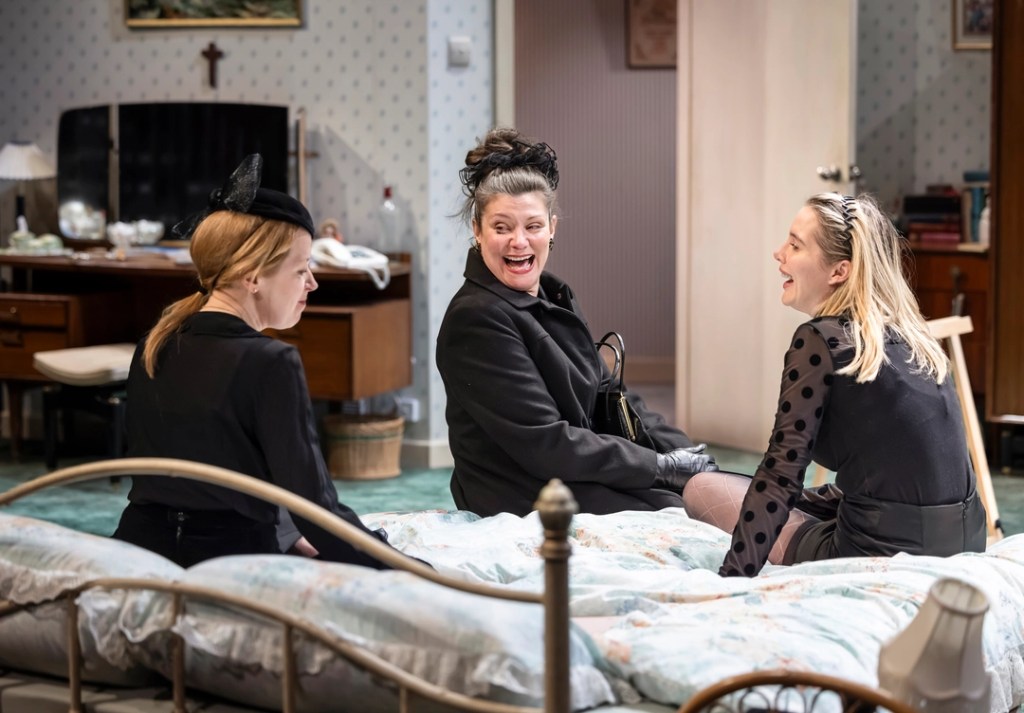
Set on the night before their mother’s funeral, the play reunites three estranged sisters in the house they grew up in, a space thick with history and unresolved tension. What unfolds is not catharsis so much as excavation: memories are contested, loyalties shift, and grief leaks out sideways through sarcasm, sibling rivalry and drink. Stephenson’s great skill is her refusal to make mourning noble. Instead, it is awkward, messy and intermittently funny, full of defensive jokes and emotional misfires. This production understands that tonal instability as a strength rather than a problem to be smoothed away, allowing humour and hurt to sit uncomfortably alongside one another.
Wakeham’s direction keeps the action moving with a light but confident touch. The rhythm of the piece- part confessional, part verbal sparring match- is handled with care, allowing moments of stillness to register without stalling momentum. Comedy isn’t pushed too hard, and emotional revelations are allowed to surface organically, often in the middle of apparently trivial exchanges where arguments flare, retreat and resurface. It’s a production that trusts both its audience and its actors to follow the emotional undercurrents without excessive signposting- refreshing in 2026.

The ensemble works cohesively, creating a convincing sense of shared history and long-standing irritation. Victoria Brazier’s Teresa, the eldest sister, is defined by tightly managed frustration and weary pragmatism. Brazier resists the urge to cement the character’s authority, instead letting it seep out through gesture, tone and habitual impatience. Reginald Edwards, as Teresa’s husband Frank, brings a grounded warmth to the role, offering moments of understated humour and emotional steadiness that gently counterbalance the sisters’ volatility. Together, their performances mostly avoid melodrama, favouring accumulation over impact.
The production’s design supports this sense of realism without demanding attention. Katie Scott’s set feels comfortably worn rather than theatrically arranged; it’s a domestic environment that suggests years of compromise, neglect and emotional hangovers. Laura Howard’s Lighting Design is used with restraint, shaping mood and focus subtly rather than signalling emotional beats too insistently. Together, they create a space that feels both recognisable and functional- a container for memory rather than a metaphor for it.

If the production occasionally plays things a little safe- some confrontations veer towards repetitive rather than freshly unsettling- it rarely loses its grip on the play’s emotional truth. This Memory of Water may not radically reimagine Stephenson’s text, but it doesn’t need to. What it offers instead is balance: between humour and hurt, nostalgia and clarity, performance and restraint.
Playing at Bolton’s Octagon Theatre until Saturday 21st February. Further information and booking details can be found here.
Tickets received in exchange for a review. #AD
Photography by Pamela Raith.
 Stagey Reviews