

After its 1993 premiere in Moscow, Slava’s Snowshow has continued to tour the world, aiming to transport audiences back to their childhood dreams and offer a welcome escape from the realities that adult life- and indeed the world- bring to the table. While this is certainly achieved in parts, the production, directed by both Viktor Kramer and creator Slava Polunin, is perhaps the most polarising I’ve attended. Some children howl with laughter throughout; others grip their adults in terror. Some adults look enthralled; others visibly yawn.

For those unacquainted, the Tony-nominated and Olivier Award-winning spectacle is a celebration of winter, accomplished by a remarkable ensemble of performers who, predominantly non-verbally, showcase classic clowning to bring the non-linear piece to life. The intricacy and physicality of each performer, aided by the whimsical costume design- also by Polunin- conjure a wide range of emotions on stage, many of which, unfortunately, are overlooked due to distractions elsewhere.

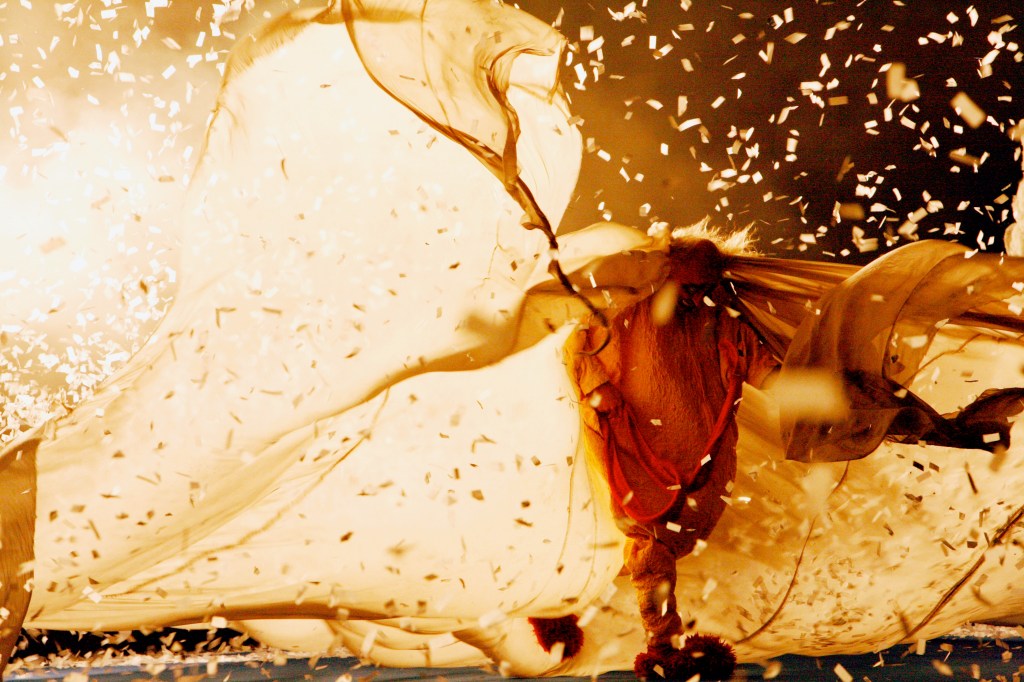
At its best, Slava’s Snowshow is a magical, visual feast. There is a scene in Act 2 that I will never forget- one that takes immersive theatre to a whole new level. Polunin’s special effects, scenography (with Viktor Plotnikov) and sound design (with Roman Dubinnikov) completely take over the theatre, creating a core memory for all patrons- at least those in the front stalls.
However, how much of it is simply smoke (and bubbles and paper) and not quite enough mirrors? While there are moments of awe, particularly for younger spectators, they come few and far between, with the audience often left anxiously waiting for the next burst of magic. The cast certainly entertain with humour and occasional poignancy, but beyond the aforementioned scene- and perhaps two others- the overall spectacle lacks finesse. The visible wires, swinging backdrops, and exposed mechanics remove some of the wonder, leaving the fever dream aesthetic feeling unfinished.

And then comes the biggest sticking point: Slava’s Snowshow only reaches its full power from the most expensive seats. The immersive elements- the snowstorms, the bubbles, the giant balls that fill the auditorium- are all designed to engulf the audience, but their full effect simply doesn’t reach beyond the premium seating area. Those in the cheaper seats miss the enveloping magic that defines the show’s reputation, making the experience feel uneven and, at times, frustratingly exclusive.
I’m not naïve to the fact that going to the theatre is a privilege, and for those lucky enough to experience it from the front stalls, it truly is a night to remember. However, for those unable to afford these seats, the production loses much of its magic, undermining its ethos of accessibility and community. Whether this exclusivity stems from rising production costs or the broader cost-of-living crisis, the result is clear- in Manchester, many seats remain empty throughout its run.
Ultimately, I will remember elements of this show forever, and for someone who visits the theatre so often, that is no small feat. Yet unless you are seated in the front rows, you may well leave wondering what all the fuss is about.
Slava’s Snowshow runs at Manchester’s Opera House until Sunday 26th October. Further information and booking details can be found here.
Tickets received in exchange for an honest review. #AD
Photography courtesy of the production.
 Stagey Reviews