

As a caveat, this production was reviewed during the opening preview due to us being unable to attend the Press Night and, as such, any technical blips or first night nerves will not be considered.
When Jonathan Harvey, playwright of the 1995-piece, Rupert Street Lonely Hearts Club, was approached to not only change the location of the piece that brought “some of the best reviews” of his career, but to bring it to 2025, he was initially hesitant. However, after some consideration, he then thought, “f*ck it”- and invites the audience to decide whether the themes and jokes are still relevant and/or interesting today. I can quite confidently say, mostly.

Harvey has an ability to give each character a profound depth that, after two hours, not only can the audience relate to, but individually, you know exactly who they are in this emotionally charged play. His ability to intertwine political commentary and social issues whilst exploring the psychology of his characters is equally superlative and agonising.
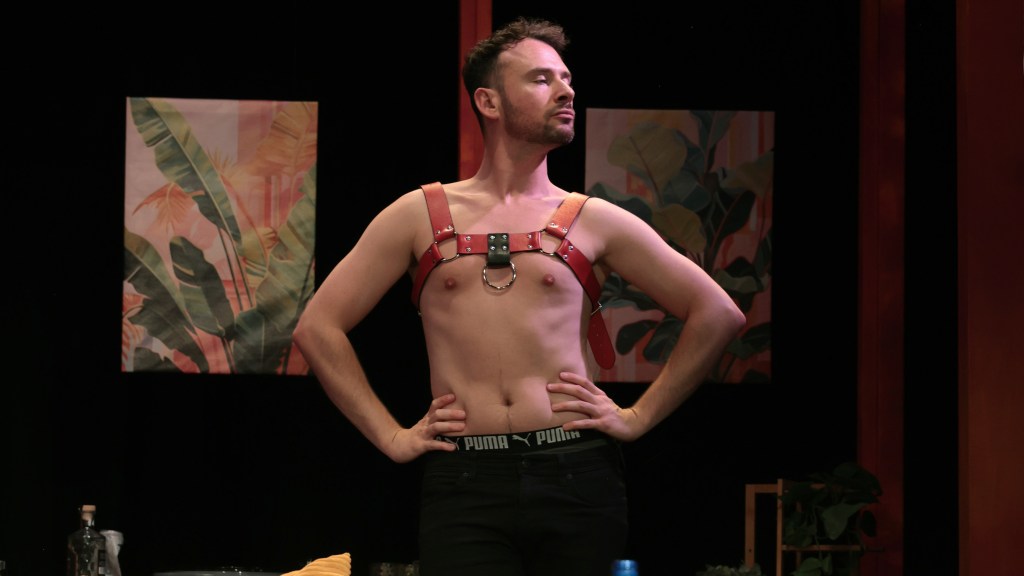
Briefly, Qweerdog’s Canal Street Lonely Hearts Club, with direction from Stewart Campbell, tells of five lost souls residing on Canal Street, all desperate for the ultimate human desire-connection. The main plot centres around reunited brothers, Marti (Cameron McKendrick) and Shaun (James Sprague) and their dynamic relationship which is equally hilarious and heart-breaking. McKendrick gives a sublime characterisation of Marti, a gay man struggling to find his way and relying on quick thrills to feel. Sprague brings an emotive portrayal to Shaun, a character who has his own internal struggles, which at times feel a little first-world but ultimately shows that all trauma is relative.
Supporting characters of Clarine (superbly played by Lucy Hilton-Jones, who shines a warm light on her character’s internal struggles), George (Riah Amelle) and Dean (Nick Collier) equally bring humour and their own heartache into Harvey’s piece. If it’s one thing Harvey can do, it’s to have the audience in hysterics one minute and bring the theatre to silence the next. It’s rare following a curtain call for the audience to be so quiet, a testament to the poignancy and thought-provoking themes displayed in front of us.

Design from Caitlin Mills is both tenable and representational of a modern urban flat, while lighting from Chris Osborn is at its best during scene transitions, showing the characters moving in real-time.
To answer Harvey’s own question, do the themes and humour resonate to a modern audience?… Occasionally, jokes which, in the 1990s, may have been familiar to the audience- regarding old movies- might have been hilarious. However, in 2025, they didn’t always feel relevant and there was some dead air. The ending, no spoilers, felt extremely quick in comparison to the rest of the piece, leaving me wondering, how did we get here? (Although, throughout, there were subtleties.) However, although the U.K. would like to believe it is a lot more liberal than it once was and that mental health is a lot less taboo, it’s clear that we still have a long way to go to help the most vulnerable in society and that everyone has their own demons that ultimately need support, whether that be from family or, as in the queer community, your chosen family.
Canal Street Lonely Hearts Club plays at Hope Mill Theatre until 14th September. Further information and booking details can be found here.
Tickets received in exchange for an honest review. #AD
Photography Shay Rowan Photography.
 Stagey Reviews