

James Graham’s Dear England returns to the stage after a brief half-time interlude, landing at Salford’s Lowry with the same skilled blend of drama, satire and sincerity that made it a hit at the National Theatre during its 2023 inception and beyond. This is no ordinary sports biopic. Instead, it’s a thoughtful, sometimes rousing meditation on identity, leadership and the slowly shifting landscape of English masculinity- viewed through the ever-scrutinised lens of the men’s national football team.
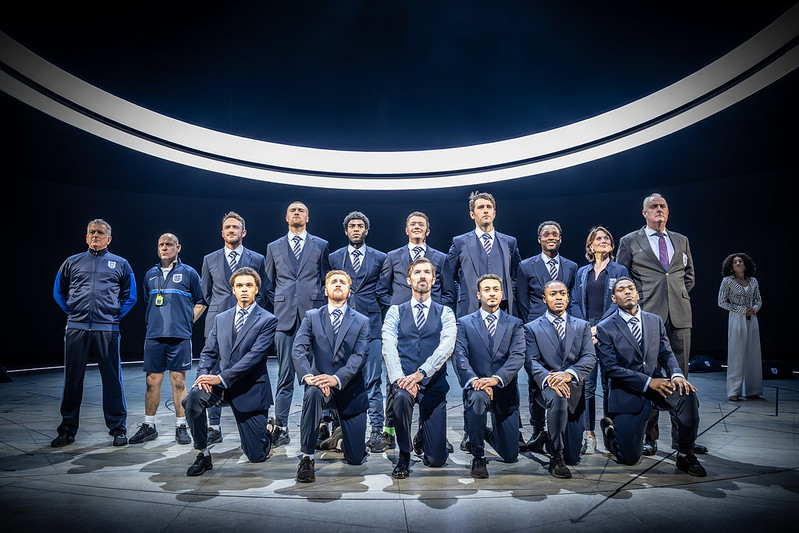
With an expertly precise turn from Gwilym Lee as Gareth Southgate, the play traces his transformation from 1996 penalty-miss pariah to quietly radical leader, reshaping not just how England plays but how its players are perceived. Under Rupert Goold’s direction and steered by Elin Schofield’s revival directorship, the production builds tension with admirable control – each match is furnished with mounting pressure and almost pinpoint movement direction (Ellen Kane and Hannes Langolf), cleverly evoking both the physical pace of professional football and the mental strain behind it. Add to this Es Devlin’s crisp, fluid set design and harmonious Lighting and Sound Design by Jon Clark, Dan Balfour and Tom Gibbons, respectively- and you’re onto a real winner.

But what lingers most are the play’s thematic ambitions. Dear England doesn’t shy away from weighty issues: mental health, racism, and the omnipresent smear of toxic masculinity are all placed under the spotlight. Southgate’s decision to bring in a psychologist (Liz White) becomes a magnifying glass through which the play explores vulnerability in a profession still too often ruled by bravado. The racial abuse faced by players after the Euros 2020 final is handled with dignity and anger- a powerful moment of reckoning.

Yet, one wonders if Graham could have pushed these themes even further. For all the nods to systemic problems- both within football and the society that surrounds it- the play tends to settle for somewhat surface-level insights. There are moments when it flirts with depth, only to pull back for the sake of momentum- which is, ironically, often slowed down by overlong penalty sequences. Perhaps it’s the format- a play can only do so much in its time frame (of which it is stretched to the longer side of comfortable). Or perhaps it’s a question of audience.
Which leads to the main question at hand: who is Dear England really for? Its tone balances just enough satire to keep football fans engaged, but its delivery- polished, articulate and often earnest- feels aimed at a regular theatre crowd. If part of the point is to challenge football’s old guard, to confront a culture that has been slow to change, is the message landing in the right stadium?

Still, it’s hard not to admire what this production achieves. As a time-capsule of Southgate’s tenure, it captures and frames a turning point- not just in sport, but in national conversation. The ensemble work is tight and the character work- particularly around Harry Kane (played expertly by Ryan Whittle), Raheem Sterling (Gamba Cole) and Marcus Rashford (Jude Charmichael)– feels affectionate without slipping into caricature. Kudos also to Felixe Forde who multi-roles fluidly between Alex Scott (of Lioness fame) and a blindingly accurate Theresa May, who is, frankly, only missing a field of wheat to run through.

This is a play that dares to ask what kind of country England wants to be. And while it doesn’t always offer the toughest, most explicit responses, it provides an emotion-felt, intelligent and, at times, unexpectedly moving reflection of a team- and a nation- trying to grow up.
Dear England plays at Lowry until Sunday 29th June, further information and booking can be found here.
Tickets received in exchange for an honest review.
Photography by Marc Brenner.
 Stagey Reviews