
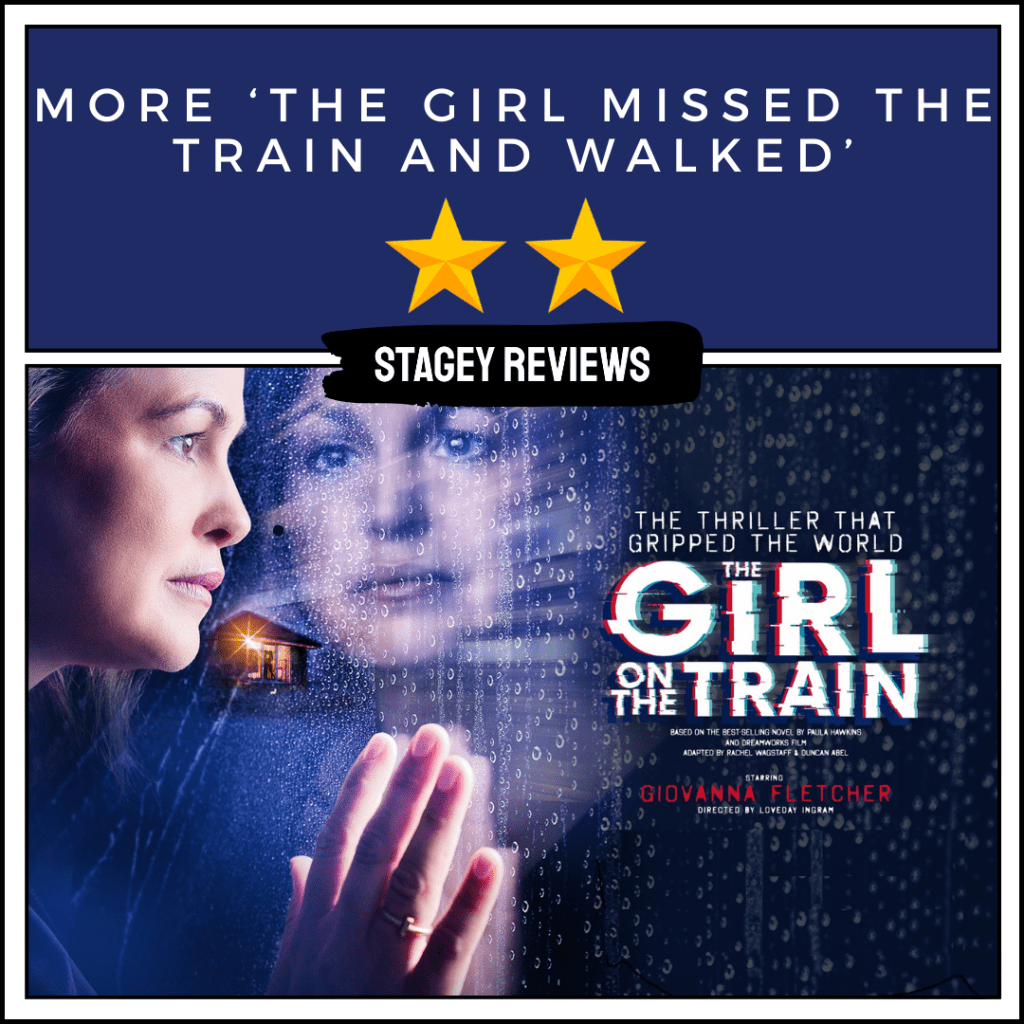
In 2015, Paula Hawkins’ The Girl on the Train soared to the top of best-seller lists globally, with its film rights being acquired even before publication- resulting in the 2016 adaptation starring Emily Blunt. Two years later, Rachel Wagstaff and Duncan Abel adapted the novel into the play we have today, having worked through several productions to varying success.
As a fan of the psychological thriller genre and, as chaotic and occasionally absurd as Hawkins’ work can be, I was hooked on this particular title and read her debut thriller in a day. Sadly, this latest outing, with direction from Loveday Ingram, is more a whistlestop tour, taking away most (if not all) of the tension and instead channelling a parody or black comedy of sorts.
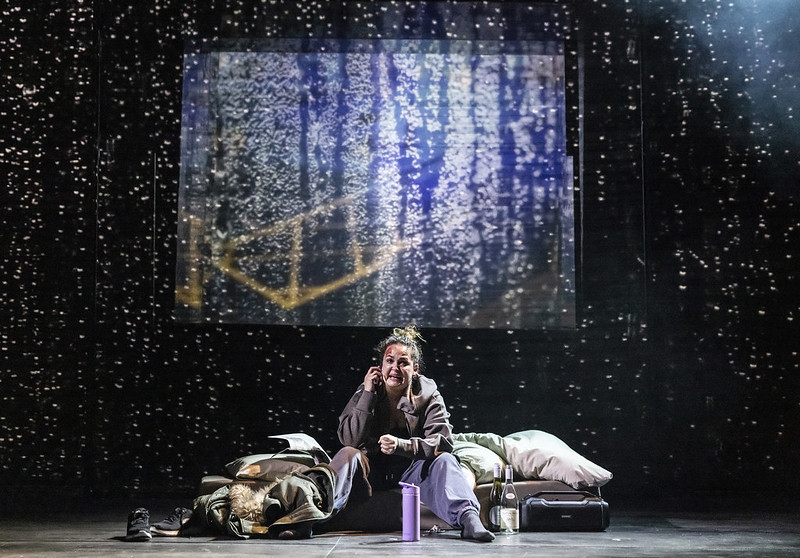
The basic plot tells of divorcee Rachel (Giovanna Fletcher), an alcoholic who has lost her job, is due for eviction and now, due to her erratic and questionable behaviour, becomes a suspect in a missing persons investigation. With spare time on her hands, she, naturally, becomes an amateur sleuth- always remaining one step ahead of D.I. Gaskill (Paul McEwan). As straightforward as this sounds, the original story is crammed with intensity and character development, which is lacking in this production. Questions arise throughout due to the scaled down book. Why is Rachel commuting to work if she is not keeping up appearances with anyone? In the novel, she has a housemate. Why does no one question Rachel sleeping on a scruffy mattress, long before she has disclosed her now being jobless? Sure, these small plot-holes may be overlooked by most, but when you become, dare I say, bored of the one note characters- particularly in Act 1, one has the time to wonder…

Where previous adaptations have been drier in delivery and in-keeping of the themes of manipulation, gaslighting and coercive control, direction here focuses on comedic delivery, resulting in amusement from the audience which draws all suspense from the piece. A standout moment, however, comes from Natalie Dunne (who superbly plays the missing Megan Hipwell), during a flashback scene in a cabin. Her delivery is powerful and emotional- paired with Dan Light’s effective video design, immersive lighting from Jack Knowles, and Elizabeth Purnell’s sound, it delivers the strongest and most penetrating scene in the play.

As leading lady, Fletcher never leaves the stage, constantly stepping in and out of scenes- but the dialogue, particularly during pivotal intense scenes, is unrealistic, stunts traction and results in two-dimensional relationships on stage. This is a recurring theme, so one must conclude it is a directorial choice. However, during scenes in Act 2, the audience gets a peek into what Fletcher is really capable of and is finally invited to somewhat emotionally invest in Rachel.
The tech tries hard to be the saving grace of this production. Purnell’s sound design reels the audience in, only to then shatter the illusion of calm moments later. Repetitive motifs are used throughout, portraying the fragmented memories of Rachel, creating illusions of disorientation. This works particularly well when showcasing costume and set designer Adam Wiltshire’s rotating cube, in which Rachel appears trapped in a cycle of mania. The minimalist, and sometimes bare set, predominantly works…

…SPOLIER AHEAD…
…until the penultimate scene. As the cloths- which are used purposefully throughout for projections and flashbacks- are pulled away, the window is no longer showing memories, but the present day on a railway track, which is consumed by the huge stage. The now flimsy, off-scale, set frames the show’s pinnacle moment. The climax we’ve been waiting for. A grizzly death for a fitting conclusion. Swiftly followed by the actor standing up, in full floodlight, walking hurriedly upstage right as a flurry of autumnal leaves falls pitifully over the scene. Murmurs of sniggering and confusion quietly consume the packed auditorium and hang around throughout the final scene. Quite the anti-climax (which still triggers sniggers upon exiting the theatre.)
Sadly, this isn’t the adaptation it used to be and, for once, it doesn’t appear to be down to budget constraints. In fact, its direction makes it less ‘the girl on the train’, and more ‘the girl missed the train and walked’.
The Girl on the Train runs until Saturday 15th February at Lowry before continuing on to tour the U.K. Further information and booking details can be found here.
Tickets gifted in exchange for an honest review.
Photography by Pamela Raith.


 Stagey Reviews
Leave a comment